
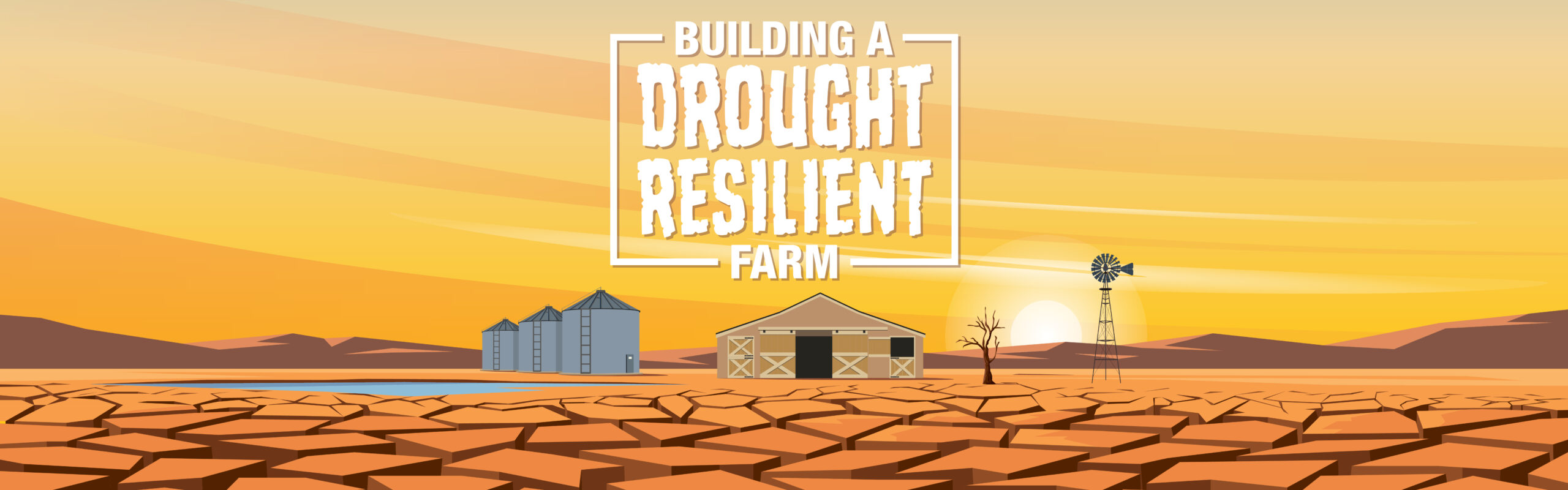
Building a Drought-Resilient Farm
What can Midwest farmers do this season in the face of extreme dry weather?
5 Min Read
Does staring at the radar ever force one drop of rain from the sky? Of course not, but it probably doesn’t stop you from looking. In reality, the only things that really matter in the face of drought are your decisions — both those you make to protect your bottom line in the season and the ones you made in the past to make your farm as drought resilient as possible for your specific geography.
In-season Actions When Moisture Runs Short
As you consider ways to handle extremely dry weather, Farm Bureau Financial Services suggests implementing a few practices to mitigate risks in season. These practices do not boost yields or increase water efficiency but are key to helping protect your bottom line and defending crop yield.
First, be aware of the additional burden that heavy amounts dust and chaff place on farm equipment. Clean farm machinery frequently to avoid safety concerns, such as impaired visuals caused by dirty windows and lights. Keep an eye on air filters and change them as needed to avoid extra wear and tear on already strained equipment.
Second, manage storage areas carefully. Monitor grain bins for unusually heavy amounts of dust, dry material and high temperatures that could increase the risk of fires.
Finally, scout fields with an eye toward identifying those that would benefit from early harvest. As crops begin to fall, yield potential is reduced and stress on harvest equipment is increased. The order in which you harvest fields will directly impact how many bushels you harvest overall.
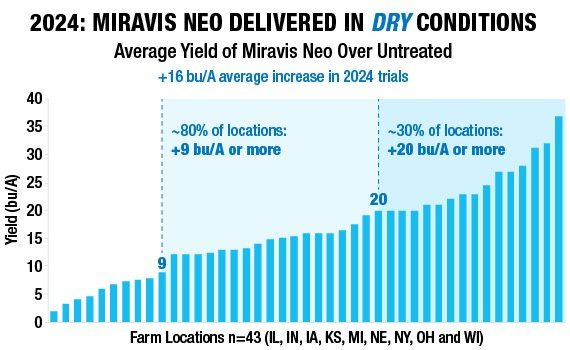
If you are looking for a more proactive strategy to strengthen crops in the field, then be sure you are applying fungicides that deliver proven plant-health benefits and make crops more drought resilient. Regardless of moisture conditions, improved plant health produces crops that better absorb light, conserve water and are more efficient to harvest. Fungicides that include ADEPIDYN® or SOLATENOL® technologies, such as Miravis® Neo or Trivapro® fungicides, are excellent ways to reduce transpiration in leaves, better retain moisture, and generally improve water and nutrient-use efficiency.
Jesse Grote, an agronomic service representative with Syngenta who covers the northwestern corner of Iowa, explains, “We have observed plant-health benefits even in the absence of really high disease pressure. Getting that protection and providing that plant-health benefit with a tassel application of a product such as Miravis Neo has contributed to strong ROI opportunities over the years across a range of conditions.”
Introduce Soil and Tillage Practices Now for Upcoming Dry Years
If you find yourself in the (slightly) more enviable position of drought preparation a season or two ahead of time, then tillage practices and soil profile improvement are major factors in drought resiliency.
No‑till farming helps protect soil aggregates and preserve crop residues, both of which improve water infiltration into the soil and reduce surface evaporation.
Soil aggregates are the natural clumps that form in undisturbed soils. Made from sand, silt, clay, organic matter and microbial life, these clumps function like sponges, creating the space where rain and irrigation water can be held until needed by the crop. Not tilling fields leaves these soil aggregates intact, allowing the soil profile to retain more moisture after rain events.
Preserving crop residue simply means leaving post-harvest crop material on top of the soil after harvest. That residue acts as an evaporative barrier, shields topsoil from direct impacts of rainfall or irrigation droplets, contributes to organic matter as it breaks down, and slows runoff so water has more time to seep into the soil.
If no-till is not a viable option for your operation, consider strip-till or contour tillage. Strip-tilling will leave at least a portion of soil aggregates intact and strips of crop residue in place, providing proportional benefits to no-till in comparison with conventional tillage.
Contour tillage aligns tillage and planting patterns with a field’s natural contours, thereby creating small ridges, keeping rain where it falls and reducing runoff. This reduces erosion and increases water infiltration.
Cover crops are a relatively quick way to improve the soil profile. They add biomass, increase microbial activity and build more stable soil aggregates. Some cover crops, such as Daikon radish and cereal rye, even help break up compacted soils by driving their roots through compacted soil, building channels in the soil structure.
Tillage and cover cropping impact the amount of water that soils are able to capture, store and have available for crops when needed. These practices may not reveal their value in a single season; but given time, they help build fields that can better withstand drought.
Improve Irrigation for Future Drought Resilience
If the time and resources to install or upgrade irrigation systems are available, that is where most operations will see the greatest impact.
The backbone of a good irrigation system is a properly sized pipeline that delivers consistent pressure. When well designed, pipelines improve irrigation uniformity and simplify future further system upgrades.
Subsurface drip irrigation places emitters below the soil surface to supply moisture directly to the root zone. Water is readily accessible to crops, and evaporative losses are reduced.
To maximize the value of irrigation systems, growers need data. Soil moisture sensors, in conjunction with an understanding of water needs at various crop growth stages, simplify choices about when and how much to irrigate. Paired with flow meters and water pressure information, irrigation management goes from educated guesses to calculated, data-based decisions.
Whether you are deciding how to handle this year’s unexpectedly dry season, which practices will diminish the impact of future droughts, or how to construct irrigation that provides your fields maximum resiliency with or without rainfall, the decisions you make will have major impacts on your operation. Drought is unforgiving. Do your best not to need mercy.

RELATED PRODUCTS


RECOMMENDED FOR YOU