


Peanut Rx Helps Strengthen Pre‑Plant Decisions
The digital version of the Syngenta Peanut Rx tool makes it easier than ever to compare varieties and plan field-specific disease programs.
5 Min Read
If you have grown peanuts for any length of time, then you are likely familiar with one version or another of the Syngenta Peanut Rx tool. But if not, Wilson Faircloth, Ph.D., an agronomic service representative with Syngenta who covers western parts of Georgia, lower Alabama and the Florida panhandle, is the perfect person to explain it. Faircloth, known also as the Peanut Doctor, has worked on the Peanut Rx tool for going on 14 years.
“Peanut Rx is an adaptive tool and that’s what sets it apart,” Faircloth says. “It allows the grower to customize fungicide spray programs to their specific conditions, and that’s why it’s so helpful to farmers.”
Paper Checklist to Digital Engine
Even if you are familiar with Peanut Rx, you may not be aware of the digital upgrades that it has received in the last two years.
Faircloth says that Peanut Rx is about 20 years old. The tool was developed through the cooperation of agricultural extension services from Alabama A&M University, Auburn University, Clemson University, Mississippi State University, North Carolina State University, University of Georgia and University of Florida. Syngenta partnered with them, helping put their ideas together and format them into a user-friendly tool.
Originally, Peanut Rx focused primarily on tomato spotted wilt virus. But over the years, as stronger resistance to tomato spotted wilt was bred into peanut varieties, Peanut Rx expanded to take fungicide treatments into account as well. Starting as a paper checklist, the Peanut Rx tool allowed users to allocate points to a field depending on how questions about the field were answered. The points were tabulated, risk to the field was assessed and disease treatment programs prescribed.
That system evolved into the digital Peanut Rx tool of today. Syngenta updates the tool each year with the latest peanut varieties, so growers can compare what’s new alongside proven standards. Many Syngenta representatives still keep a few of the paper Peanut Rx checklists available to hand out upon request, but the digital version has been well-received by most peanut growers.
“It’s been very heavily used in the last year,” Faircloth says. “Syngenta saw this as the next logical iteration of the tool. Life is digital now, so we moved everything to a platform where growers can have the convenience of Peanut Rx at their fingertips anywhere.”
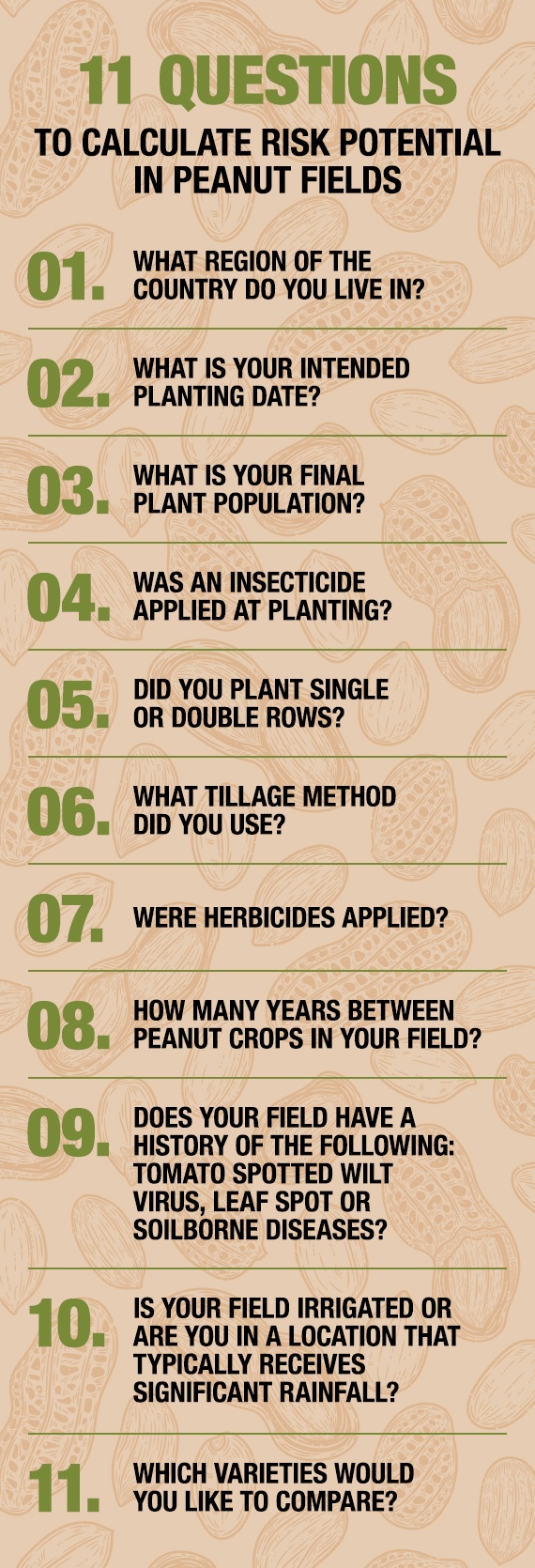
Once the answers to the above 11 questions are entered, the Peanut Rx tool calculates your risk level and recommends a treatment program. Risks that Peanut Rx evaluate include white mold, early leaf spot, late leaf spot and Rhizoctonia limb rot. The treatment programs suggested by Peanut Rx can help peanut growers mitigate disease risk, maximize application flexibility, improve peanut quality and increase yield potential.
Choose Peanut Varieties With Confidence
In the past, Peanut Rx was mainly used after key decisions were made, primarily to fine-tune spray programs. With the updated tool, it can also support pre-plant variety and field placement decisions.
Each year, the Syngenta team reviews which new peanut varieties have been released and are favored by growers. That is critical because one aspect of the tool is the ability to compare multiple peanut varieties at a time.
If you’re making decisions about which varieties to plant, Peanut Rx can demonstrate the implications of placing different varieties in different locations. “A grower can review hypothetical planting plans and understand that ‘if I plant variety X, then I may have to concentrate on leaf spot, whereas if I plant variety Y, I can back off on my leaf spot applications a little because the variety itself has a little more inherent tolerance to leaf spot,’” Faircloth says.
Weather Warnings Shape Threats
2026 is shaping up to be the kind of year that perfectly demonstrates the value of Peanut Rx. Weather predictions in the Southeast are notoriously difficult; knowing which peanut diseases will be the most destructive each year is tough. It is, however, a safe bet that some disease will be present. 2026 is predicted to be an El Niño summer, which usually means a fair amount of rain. Because of that, Faircloth expects leaf spots to be prevalent and white mold to be less of an issue. But he is quick to add that that is a broad, overall prediction and everything just depends on local geography and climate conditions at a micro level.
Faircloth points out that sometimes growers are not overly focused on a peanut variety’s leaf spot characteristics. However, in a year where leaf spots are likely to be more of a yield-limiting factor than white mold, the tool could help many see the stark differences in leaf spot resistance between varieties. That is exactly the sort of proactive decision that can save money on disease treatment and increase yield potential at the end of the season.
Forecasting the Future of Peanut Rx
The digital model opens the door for all sorts of future upgrades. Peanut Rx is not a crystal ball, but it is not hard to imagine linking the tool with weather prediction software in the future to help make even more customized in-season recommendations. Those sorts of possibilities excite Faircloth. When a center pivot breaks down in an irrigated field, a farmer can pull out a phone, update conditions, and get real-time guidance on what to adjust or which diseases to watch — something that no longer feels far fetched.
Faircloth acknowledges that peanut farmers are facing a tough economy, and he hopes that using Peanut Rx could help growers gain a competitive advantage and make decisions a little easier. “I expect farmers to be managing their pennies a little tighter this year, but we’re excited for another year,” he says.
The digital version of Peanut Rx provides a clearer view of field-by-field risk, showing farmers their options and the economic implications of each choice long before the sprayer hits the field. In another year when every input dollar has to work harder, Faircloth believes most peanut producers in his area understand that investing on the front end usually pays off in peanut production down the road.

RECOMMENDED FOR YOU