


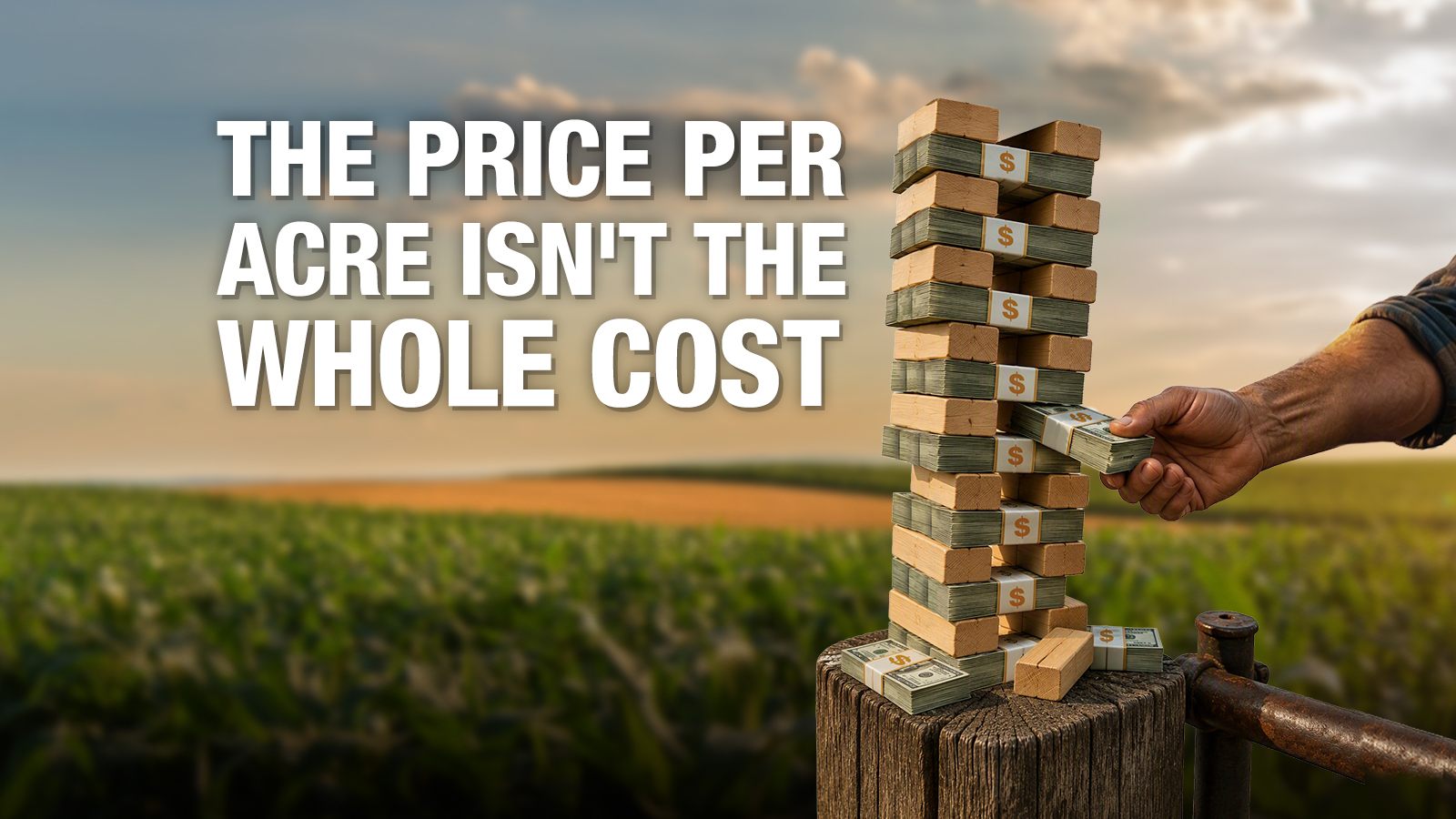
The Price Per Acre Isn’t the Whole Cost
A lower herbicide price may look attractive on paper, but hidden costs can emerge long after the purchase decision is made.
5 Min Read
Every input deserves scrutiny in today’s farm economy.
From seed and fertilizer to fuel and crop protection, growers are evaluating every line item to protect margins. According to Jeremy Sharp, corn herbicide product lead at Syngenta, that’s exactly what they should be doing.
“Growers should know what’s going into each acre,” Sharp says. “But when evaluating herbicides, the question isn’t about which product costs less but rather what will this decision ultimately cost me by the end of the season?”
It’s easy to compare purchase prices, but many of the costs associated with crop protection don’t appear on an invoice. “Purchase price is one part of the equation, but it’s not the whole equation,” Sharp says.
The Cheapest Option Isn’t Always the Lowest-Cost Option
Many herbicide decisions begin with two comparisons: active ingredients (A.I.) and cost per acre.
Those are important considerations, but they don’t tell the entire story, according to Jeremy Fowler, Ph.D., group leader of formulation development at Syngenta.
“Depending on the formulation, you can have dozens of ingredients beyond the active ingredients and those pieces create a very complex formulation package that’s designed to not only give you outstanding efficacy in the final product itself, but stability over a wide range of conditions,” Fowler says.
Those additional formulation components may include emulsifiers, stabilizers, pH buffering systems, antifoam agents and other ingredients designed to help products remain stable, compatible and effective under real-world conditions.
When evaluating herbicides, the question isn’t about which product costs less, but rather what will this decision ultimately cost me by the end of the season?
Sharp sees the same issue from a grower’s perspective.
“The active ingredient is part of the calculation, but it isn’t the only calculation,” he says. Understanding that difference becomes important when products reach the tank and the field.
Hidden Cost #1: Tank-Mix Problems
Today’s herbicide programs often require multiple products, adjuvants and tank-mix partners. When ingredients are not designed to work together, problems can develop quickly. Fowler notes that compatibility is one of the key challenges formulation scientists work to solve long before a product reaches the marketplace.
“The big difference, and where generic herbicides may have different levels of time and resources invested, is to make sure that all ingredients are compatible in the formulated product,” Fowler says. “Growers can’t afford surprises.”
Sharp has seen those surprises with some generic herbicides firsthand. “I’ve seen way too many tanks turn to pancake batter on us,” he says.
Products that settle, crystallize, separate or become too thick to pump can create immediate challenges. In some situations, the mixture can be recovered. Even when a mixture appears usable again, another concern remains. “Am I getting too much A.I. in one place and not enough somewhere else? And then suddenly I’ve got skips or crop response in the field?” Sharp says.
Hidden Cost #2: Equipment Downtime
A problem in the tank often becomes a problem in the sprayer.
Settled material can clog screens, jets and pumps. Crystallization can create cleanup challenges. Equipment may sit idle while operators troubleshoot compatibility issues during critical application windows.
Sharp has spent years helping diagnose those situations and understands the impact on operations. “That is downtime. And that is very, very bad news for the person that’s got to deal with that,” he says. “I’ve had to help clean many tanks where DIY mixes went south. That’s not a good day.”
The hidden cost is not simply the cleanup. It’s the lost opportunity to spray while conditions are favorable. When application windows are measured in days rather than weeks, even minor delays can have consequences.
Hidden Cost #3: Weed Escapes and Rescue Applications
Tank-mix issues don’t always reveal themselves immediately.
Sometimes the evidence appears weeks later as weed escapes or inconsistent control across the field. Sharp explains that uneven distribution of active ingredients can create areas where weeds receive less than intended rates. “It’ll look just like skips,” he says. In those situations, growers often face an additional expense in the form of a rescue application.
“If you run into a scenario where you have less weed control and it’s not working the way you would expect, you’ll need to go back in with a potentially costly rescue application,” Sharp says.
That cost can include:
- Additional chemistry
- Fuel
- Labor
- Equipment wear
- Another trip across the field
- Continued weed competition for this season and next
What initially looked like a lower-cost choice can quickly become far more expensive.
Hidden Cost #4: Going It Alone
One of the easiest costs to overlook is support.
When a product doesn’t perform as expected, growers need answers quickly.
According to Fowler, that support network is one of the major differences between branded products and many generic alternatives.
“Our customer support center has access to global expertise and responds directly to suppliers, distributors and growers. We aim to ensure that their experience is the best they can get,” he says.
Sharp agrees.
“That’s why 1-866-SYNGENTA exists, so you can have dedicated U.S.-based support beyond the sale of the product,” he says. Whether the question involves performance, compatibility or application issues, growers have access to technical and agronomic resources after the product leaves the retailer.
What You’re Really Buying
When growers purchase a branded herbicide, they’re buying more than the active ingredients listed on the label. According to Fowler, formulation development requires significant time and scientific investment.
“Beyond the time spent to discover and determine if a new herbicide molecule can come to market, we spend at least two years testing a wide range of scenarios for compatibility and performance,” he says. “The longer timeline for development allows us to spend more time doing more experiments, refining stability criteria and checking a wide range of different conditions over an extended period of time.”
The goal is simple: Help products perform consistently and predictably under a wide range of conditions. “Any additional ingredients in our products are not simply fillers,” Fowler says. “They are carefully selected formulation components intended to improve stability, reliability and performance.”
Sharp believes that investment ultimately benefits growers. “When you stick to a formulated, branded product from Syngenta, we’ve worked through all of that for you,” he says.
Four Questions to Ask Before Choosing a Herbicide
Before selecting a herbicide primarily on purchase price, consider asking:
1. What is included beyond the active ingredients?
Formulation technology, stability systems, compatibility work and application testing may influence performance.
2. What additional products or management will this program require?
Consider surfactants, conditioners, compatibility agents and any other inputs needed to keep products working together.
3. What happens if performance falls short?
Think about the costs of downtime, weed escapes and rescue treatments.
4. Who stands behind the product?
Evaluate the agronomic, technical and customer support resources available after purchase.
Ask the Real Cost
In a tight-margin environment, scrutinizing every input makes sense. The next time two herbicides appear similar on paper, look beyond the active ingredients and the price per acre.

RELATED PRODUCTS

RECOMMENDED FOR YOU