

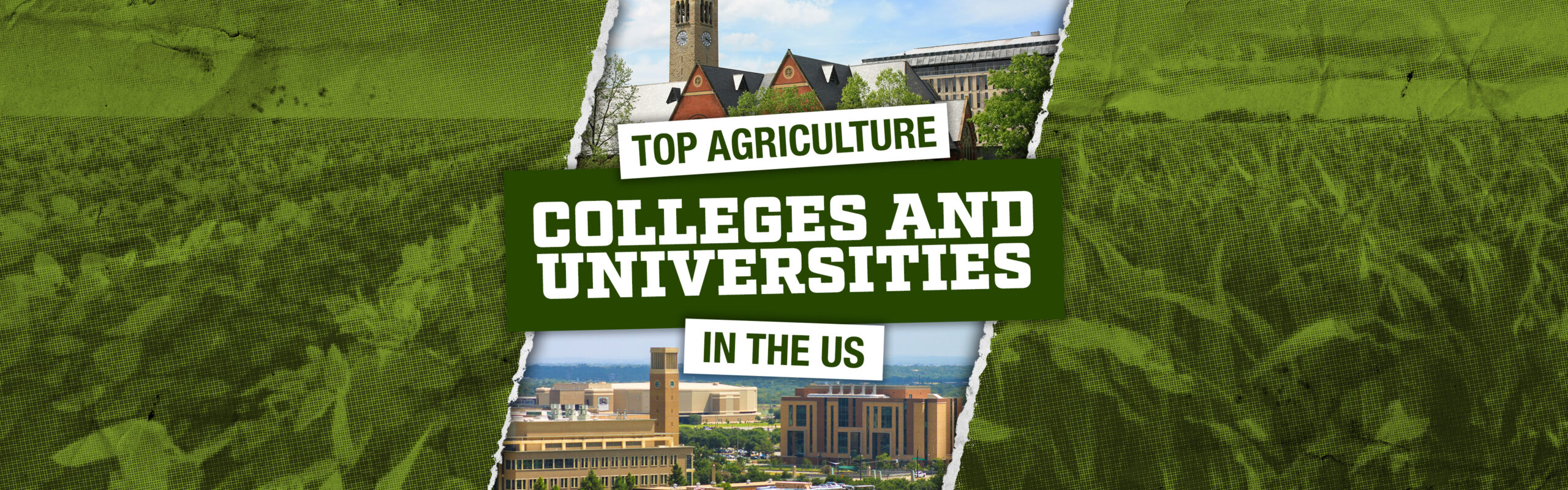
Top Agriculture Colleges and Universities in the US
Explore leading agricultural programs, HBCUs, popular ag majors and career pathways to help find the right fit for your future.
11 Min Read
Choosing which agricultural college to attend is one major step toward a career in ag. Students seeking top agricultural programs know they want to feed the world, solve problems or steward the environment; but deciding among the many strong ag programs in the U.S. can be daunting. Knowing what to look for can help students navigate the boundless options and find the right fit for their aspirations.
What Makes a Great Agricultural School?
Many top agricultural schools are land-grant universities, meaning they were established to broaden access to higher education and advance agriculture. Beyond that, their purpose is for their graduates to serve their communities.
To support that mission, many leading schools invest heavily in hands-on learning, research opportunities, accomplished faculty, modern facilities and a wide range of degree programs. Based on 2026 rankings from Niche, this list highlights the traditional top ag universities in the U.S., based on Department of Education data, research investments and other factors. But don’t stop there — there’s much more to discover. We compiled experiential learning programs, historically Black colleges and universities (HBCUs), and more standout curriculums.
Top Agriculture Colleges and Schools in the U.S.
1. Cornell University, Ithaca, New York
The only land-grant institution in the Ivy League, Cornell University is home to a world-class College of Agriculture and Life Sciences, which offers 21 undergraduate majors and more than 40 minors focusing on agricultural, life, environmental and social sciences. Students can pursue a variety of traditional and emerging career tracks.
2. Texas A&M University, College Station, Texas
Texas A&M University is the largest college of agriculture and life sciences in the country by student enrollment. It’s home to 15 departments led by accomplished faculty in fields such as agricultural economics, leadership, communications, engineering, plant pathology and soil sciences. Undergraduates can choose from 30 majors, numerous minors and certificates.
3. University of Florida, Gainesville, Florida
Despite having one of the largest student bodies of universities on this list, the College of Agricultural and Life Sciences at the University of Florida boasts the lowest student-to-faculty ratio on this list at 11:1. The student experience is highly customizable. Students can explore more than 50 specializations with an online quiz or enrich their experience by participating in any of more than 45 student organizations.
4. University of Illinois Urbana-Champaign, Champaign, Illinois
Students from the University of Illinois Urbana-Champaign’s College of Agricultural, Consumer & Environmental Sciences make an impact in and beyond Illinois through internships, volunteer opportunities and more than 400 study abroad programs. Over 80% of students participate in experiential learning throughout their pursuit of a degree.1 The college awards $4.3 million annually in scholarships.2
5. Kansas State University, Manhattan, Kansas
The Kansas State University College of Agriculture reports that 97% of last year’s graduates are employed or pursuing further education.3 Programs range from traditional crop and livestock management programs to degrees in agricultural economics, food science, horticulture and more. Most majors offer opportunities for undergraduate research where students work hand-in-hand with faculty and staff mentors.
Other Standout Agricultural Programs Worth Considering
For students interested in studying closer to home or institutions that align with their interests and learning style, other quality universities may offer a better fit. Many agricultural programs excel in multiple categories.
Really great ag schools allow experiential learning and experiences for their students. Schools that have unique student organizations and opportunities are preparing those students for successful careers.
“Really great ag schools allow experiential learning and experiences for their students,” says Kaci Rice, talent program manager for Syngenta. “Schools that have unique student organizations and opportunities are preparing those students for successful careers.” That includes internships with agribusiness companies like Syngenta, where summer internships are professional experiences with real projects that impact the business — connecting educational learning with hands-on experience.
Strong Research Universities
Schools focused on research allow students at all levels, including undergraduates, to work with professors at leading research laboratories. Student employees gain practical experience working with technology, managing details for accuracy and solving problems. Rice notes these skills translate well to careers.
North Carolina State University, Raleigh, North Carolina
North Carolina State University is a Research I university, meaning it makes significant investments in cutting-edge facilities run by industry-leading faculty. The university supports over 60 projects across 70 commodities and 19,000 acres across the state. In addition to on-campus research, NC State staff and students operate in 18 research stations throughout the state.
Purdue University, West Lafayette, Indiana
Multidisciplinary research within the College of Agriculture at Purdue University addresses major challenges in agriculture and life sciences. A total of 38 centers, labs, institutes and programs bring research faculty and other partners together to meet specific research needs. On campus, 18 research facilities and services, including The Student Farm run by several student groups, provide access to resources needed to conduct that research.
Texas Tech University, Lubbock, Texas
Collaborative research at the Texas Tech University Davis College of Agricultural Sciences & Natural Resources encourages students to work alongside faculty. Eight research centers and $19.6 million in research support extend funded research opportunities even to undergraduates.4 Globally, collaboration includes research sites on six continents.
University of Idaho, Moscow, Idaho
As Idaho’s only Research I university, the University of Idaho encourages students to gain in-depth experience at research locations. The College of Agricultural and Life Sciences supports the largest research dairy in the U.S.; a working research ranch; crop research on barley, mustards, potatoes and wheat; the Aquaculture Research Institute; and more.
Schools Known for Hands-on Learning
For those who learn best by getting their hands dirty, look for college programs that encourage time in the lab or curriculums that prioritize projects over papers. Rice says these classes and experiences make great interview points during their job search.
University of Georgia, Athens, Georgia
To graduate, all University of Georgia students must engage in hands-on, experiential learning either domestically or abroad. Though this became a university-wide requirement in 2016, it has always been a priority for the College of Agriculture & Environmental Sciences. Opportunities to fulfill this requirement include work in the field or lab, internships, service-learning, study abroad, and more.
Iowa State University, Ames, Iowa
Iowa State University actively encourages students to get real-world experience. The College of Agriculture and Life Sciences supports students in finding internships, studying abroad and starting their own businesses. Iowa State manages 15 research and demonstration farms throughout the state, and opportunities include a farm management course where students work together to manage a crop and livestock farm.
Cal Poly, San Luis Obispo, California
“Learn by Doing” graces the shield of the Cal Poly logo, representing the school’s core philosophy. The College of Agriculture, Food and Environmental Sciences employs that approach through research and experience labs on ranches and in orchards, vineyards and forests. Student-run enterprises also provide hands-on, real-world experience.
Schools With Broad Agricultural Degree Options
For students who know they want to be involved in agriculture but don’t know exactly where they fit, universities with an abundance of majors can help them find the right path. Additionally, programs with broad majors and flexible specialization could be good solutions for these students. Rice adds that schools rich in science and technology majors provide education that transfers well to careers in agricultural research and development.
University of California Davis, Davis, California
The College of Agricultural and Environmental Sciences at the University of California Davis, or UC Davis, offers undergraduates 27 majors in 14 departments, as well as an exploratory/undeclared option, plus 40 minors, all within a top-tier research university. The college expects many students to be unsure about their career path when they start college, and programs are designed to help guide them to the right fit.
Oklahoma State University, Stillwater, Oklahoma
Oklahoma State University combines 16 majors and 18 minors in the Ferguson College of Agriculture to offer more than 50 study options for undergraduates. It also offers more than 30 graduate degrees. To help students find their place in agriculture, Oklahoma State emphasizes learning both within and outside of their majors alongside experiential learning.
Virginia Tech, Blacksburg, Virginia
Academic programs within the College of Agriculture and Life Sciences at Virginia Tech balance specialization with the fundamentals for ongoing professional growth. Students can choose among associate, bachelor’s and advanced degree programs; freshmen can enter with the designation of “Exploring Life Sciences” for a broad foundation before selecting a major. The university also prioritizes research, hands-on learning and service.
Leading HBCUs for Agriculture Degrees
Since the early 19th century, HBCUs have provided distinct opportunities for students of color.
Many HBCUs were founded as agricultural and engineering institutions but later expanded their academic disciplines. Today, several HBCUs with strong agricultural programs attract students looking to pursue their education in a diverse environment. Based on Niche’s 2026 rankings, we compiled five leading HBCUs for agricultural sciences in the U.S.
1. Alcorn State University, Lorman, Mississippi
Alcorn State University is the oldest public historically Black land-grant institution. Alcorn State has a focus on professional development and experiential learning opportunities. Students have access to greenhouses, orchards, vineyards, swine research, Mississippi River research and state-of-the-art laboratories.
2. Florida Agricultural & Mechanical University, Tallahassee, Florida
The National Science Foundation recognized Florida A&M as the top HBCU for research and development. The land-grant arm of the university, the College of Agriculture and Food Sciences, is home to three specialized research centers in the areas of viticulture and small fruit, water resources, and biological control. Students have opportunities to make respected contributions to agricultural research and gain real-world experience along with their education.
3. Tuskegee University, Tuskegee, Alabama
The founders of Tuskegee University envisioned an institution focused on hands-on agricultural education and the use of science to improve life for farmers and communities. The College of Agriculture, Environment and Nutrition Sciences offers nine undergraduate degree programs, numerous graduate degrees and several interdisciplinary doctorate programs, all aimed at preparing students for careers in the agriculture and food value chain.
4. North Carolina A&T State University, Greensboro, North Carolina
The largest HBCU in the U.S., North Carolina A&T focuses on excellence in science, technology, engineering and math (STEM). That includes its College of Agriculture and Environmental Sciences, also the largest agricultural college by student body size among HBCUs. Its working 581-acre University Farm allows students to gain experience supporting current industry research as they pursue degrees in nine undergraduate and three graduate degree programs.
5. Prairie View A&M University, Prairie View, Texas
Prairie View A&M’s College of Agriculture, Food and Natural Resources emphasizes academics, research and extension, following the land-grant tradition. It was the second public university established in Texas, located in a rural area beyond suburban Houston. Degree programs encourage students to earn a well-rounded education with hands-on experience in the food lab, meat lab or on the farm.
Agriculture Degrees and Specializations Offered at Top Schools
The specifics of programs and degrees vary between institutions, but students attending agricultural colleges usually earn Bachelor of Science degrees in their programs. Most schools offer degrees in the following categories, each leading to a broad range of jobs. For more specifics or areas not covered here, students can use tools like the National FFA Organization’s Ag Explorer.
Agronomy, Crop Science and Plant Science Programs
These studies focus on plants. Learn how they grow, how to protect and improve yields, how to manage pests, and more. Potential career paths include — but are not limited to — advising farmers on crop management, breeding plants or understanding disease threats to develop solutions.
Agribusiness and Agricultural Economics
In agriculture, like any business, dollars and cents matter. Degrees and specializations in this area lead to careers in ag financing, sales, business management, market analysis and more.
Agricultural and Environmental Engineering
Engineering is for students fascinated by how things work. Degrees in engineering prepare them to build and improve farm machinery, buildings, crop handling systems, precision agriculture tools and much more.
Animal Science
For more than just aspiring veterinarians, degrees in animal science also prepare students to become animal nutritionists, meat scientists, geneticists and others who support animal agriculture. Some schools include specializations for companion animals as well.
Biotechnology
Delve into the cellular and molecular level of plants and animals in this field. Degrees in this area tend to lead toward the research and development of solutions to challenging problems, like how to alter plants to better manage stress or curate soil microbes as effective crop protection products.
Food and Nutrition Science
Feeding the world is more than just growing crops and raising animals — it’s processing those raw ingredients into accessible food. These degrees apply science to making the food supply safe, nutritious and sustainable as it moves from farms to plates, and leads to jobs at food companies throughout the supply chain.
Natural Resources and Environmental Sciences
For those interested in understanding and improving soil, water and ecosystems, degrees in natural resources lead to careers in conservation management, soil health improvement, water quality protection and more. These programs often focus on long-term sustainability of agriculture, balancing nature and human needs.
What Should Students Look For in an Agricultural Program?
Universities tout their reputations, academics, rankings, research, opportunities, athletics, alumni, campus life and more. All those factors matter.
In addition, Rice encourages students to consider how a school will help them prepare for opportunities after graduation. She offers a few less-obvious characteristics that set an agricultural program apart.
Industry-Focused Career Services
“Schools with an active career services department or office help students find internships and jobs,” Rice says. “They form relationships with companies that hire new graduates.”
She believes career fairs are important, but they can be really big and intimidating.
“I’ve seen a shift in career services also allowing companies to sign up for classroom visits or tours, allowing them to interact with students in a more intimate setting,” she says.
Active Student Organizations
Rice sees value in all types of campus involvement and leadership. She recommends students get involved in an organization within their major, as well as in broader industry organizations.
“At Syngenta, we support Agriculture Future of America and MANNRS, which is Minorities in Agriculture, Natural Resources and Related Sciences,” she says. “Those partnerships allow companies like us to connect with students who attend key organizational events.”
Unique Partnerships With Industry
As part of local, regional and global communities, universities build special partnerships that can benefit students in their job and internship searches. Finding and participating in these programs offer students deeper access to opportunities.
For example, Rice says Syngenta, with headquarters in Greensboro, North Carolina, participates in NC State’s Accelerate to Industry event, where company representatives listen to research talks from students working toward their master and doctorate degrees. Several regional companies, including Syngenta, sponsor SciTech Week at North Carolina A&T. And Syngenta offers internships to HBCU students through the North Carolina Governor’s Program.
“We are expanding our relationship with Southern University and A&M College, an HBCU in Baton Rouge, Louisiana, because they are really close to our St. Gabriel facility,” Rice says. “We go to their career fair and we are working with their MANNRS chapter.”
Similar relationships, unique to the community, exist through agricultural programs throughout the country. The possibilities for a strong agricultural education are endless.
1 https://aces.illinois.edu/
2 https://aces.illinois.edu/
3 https://www.k-state.edu/news/articles/2026/02/post-graduation-outcome-success-report.html
4 https://www.depts.ttu.edu/agriculturalsciences/

RECOMMENDED FOR YOU