
Weather Moves Soybean Disease Threats Beyond State Lines
Preventive fungicides safeguard soybean yields from shifting weather patterns and disease pressure.

Thanks in part to unrelenting rain and high humidity levels this past season, soybean growers experienced unusual weather conditions that were optimal for disease development. As a result, many growers scrambled to decipher which diseases were in their fields, making quick fungicide applications in an effort to salvage yields.
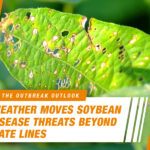
Two diseases of concern in 2025 were frogeye leaf spot and white mold, as both diseases are adapting to new environments. Once known as a strictly Southern disease, frogeye leaf spot has adapted to Midwestern conditions, spreading north into the Corn Belt and infecting Indiana and Illinois soybean fields.
In contrast, white mold pressure came in early July, moving southward down the continental U.S. According to Dylan Mangel, Ph.D., assistant professor and extension plant pathologist with University of Nebraska–Lincoln, he’s anticipating record yield losses due to white mold.
“This is no longer a disease of Northern states. White mold has moved down and gotten really comfortable here in Nebraska,” says Mangel. “It’s evolving and getting more used to the conditions here. The more they get used to it, the more we’re going to see it.”
Many soybean growers also had to contend with Cercospora, pod and stem blight, and Septoria brown spot. For added complication, this intense disease pressure hit earlier in the season than normal. Many soybean fields applied yield-saving foliar sprays in July rather than August, creating difficulty in finding someone available to spray quickly.
It’s clear that diseases can take a big bite out of profits — stealing an estimated 250 million soybean bushels in the U.S. in 2024 — making preventive fungicides an essential part of yield protection strategy.
Plan Ahead to Protect Soybean Yields
One key takeaway from 2025 is the value of a preventive fungicide application. Some growers often take a wait-and-see approach to soybean fungicides, hoping to skip an application if disease pressure stays low or conditions are dry.
However, the unexpected pressure of 2025 showed that playing fungicide application by ear is a risky gamble. Plus, a late fungicide application cannot reverse established disease pressure. The best way to protect ROI and maximize yield potential is with a proactive approach.
Yield Protection in Wet or Dry Conditions
Whether you end up battling disease in your fields or not, the Cleaner & Greener* plant-health fungicide portfolio can help safeguard your soybean crop. Whether there’s light or heavy disease pressure, these high-performing products cover your bases with proven disease control and plant-health benefits to boost potential yield — regardless of conditions.
Miravis® Neo fungicide can help soybean growers fight back against yield-robbing Midwestern diseases like white mold. Containing the exclusive powerhouse SDHI molecule ADEPIDYN® technology, Miravis Neo combats all key diseases and dominates spots and blights. This next-level control maximizes soybean yield potential and supports overall plant health. In 2024, Miravis Neo delivered an average 5-bushel advantage over the untreated check, beating breakeven in 87.5% of trials.1
Another powerful option for soybeans is Miravis Top fungicide. Miravis Top combines two active ingredients — including ADEPIDYN technology — to provide broad-spectrum disease control against the toughest soybean diseases, including strobilurin-resistant pathogens such as frogeye leaf spot. A combo of high-performing disease protection and proven plant-health benefits helps maintain maximum yield potential.
No matter what 2026 brings, Mother Nature is sure to keep growers on their toes. But this time around, you can be ready. Act now to reserve Miravis Neo and Miravis Top supplies for the next growing season and be one step ahead of yield-robbing diseases.
*No claim is being made herein about the environmental attributes of any product. References to “cleaner and greener” indicate plant health benefits (e.g., less disease and increased crop efficiency and productivity) from foliar fungicides and the visible color of the plants.
1On-farm grower/strip trials (n=8): IA (2), IL (1), IN (1), MI (1), NE (1), SD (1), WI (1). Application Rates: Miravis Neo fungicide at 13.7 fl oz/A applied at R2-R3 soybean. Break-even return on investment (ROI): Application + product cost = ~$31/A / soybean price $10/bu = 3.1 bu/A.

3 Min Read
- Due to unusual weather conditions, soybean growers experienced many unprecedented disease challenges in 2025.
- Fungicide applications were necessary to protect soybean yields, and many growers struggled to apply ahead of the season’s outbreaks.
- A proactive strategy with Syngenta fungicides can protect crops from disease outbreaks and boost yields even in low-pressure years.


More Articles About Field Insights



RECOMMENDED FOR YOU